
Higher Level Apprenticeship in Culinary Arts
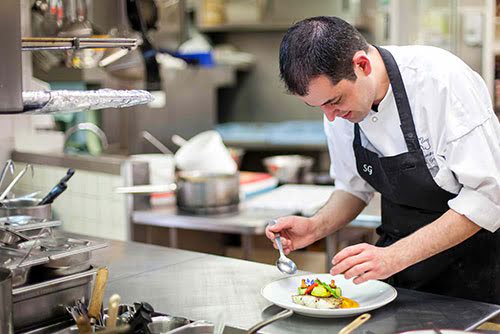
You will complete a Foundation Degree in Culinary Arts (Validated by The Open University) which will produce industry focused graduates who have an in-depth knowledge of the core principles of Culinary Arts with a practical understanding of how theory informs professional practice in preparation for a career in the wider Hospitality Industry and/or progression directly to higher qualifications either through the professional bodies or University.
This 3 year programme provides a strong vocational content delivered through Hospitality & Culinary Arts specific modules. You will be presented with opportunities to acquire and enhance academic, technical (industry specific) and transferable skills (communication, organisational skills, problem solving, leadership, critical thinking) which will help you to apply to relevant jobs within the Hospitality & Culinary Arts industry.
Modules Include:
- Work Based Learning Research & Study Skills
- Food Photography and Social Media Presence
- The Compliant Kitchen
- Contemporary Patisserie and Confectionary
- The Profitable Kitchen Planner
- Modern Kitchen Culture
- Global Gastronomy
- Talent Management and Leadership
- The Innovative Chef
- The Sustainable Chef Modern
- Classical Gastronomy
This programme is based on a hybrid learning model with a focus on face-to-face delivery.
Awarding Organisation Documentation
General Entry Requirements
The general entry requirements below identify the minimum qualifications needed to apply for the programme. Other qualifications will be considered on an individual basis on application. You are required to upload a copy of your qualification certificates to show how you meet the entry requirements for the programme prior to enrolment. Applications will also require successful completion of the admissions process.
- GCSE/ Level 2 Requirements GCSE grade C/4 in English Language, or Level 2 Certificate in Essential Skills- Communication, or equivalent in an approved alternative qualification.
AND
- GCSE grade C/4 in Mathematics, or Level 2 Certificate in Essential Skills- Application of Number, or equivalent in an approved alternative qualification.
AND
- Passes in 4 different subjects (can include English Language and Mathematics and as above), with 1 at GCE Advanced (A) level (grades A-E), and 3 at GCSE level (grades A*-C/9-4), or equivalent in an approved alternative qualification.
Course Entry Requirements
- Level 3 Diploma in Kitchen and Larder and/or Patisserie and Confectionery
OR
- Level 3 Diploma n Professional Chef
OR
A minimum of 48 UCAS Tariff points including a:
- GCE A level (A2): Typical grade profile DD
OR
- Pearson BTEC Level 3 Extended Diploma with overall award profile PPP
OR
- Pearson BTEC Level 3 Diploma with overall award profile PP
OR
- Access to HE Diploma (NI): 45% overall and 45% in level 2 Access Mathematics.
OR
- An equivalent in an approved alternative qualification
Higher Level Apprenticeship Eligibility
To be eligible for a Higher Level Apprenticeship (HLA), in addition to the entry requirements identified above, you need to:
- be employed or be about to take up permanent paid employment as an apprentice, or be an existing employee moving to a new job role, allowing you to gain appropriate industrial experience, with a Northern Ireland based company (does not include public sector) who is willing to support you as an HLA candidate
- work a minimum of 21 hours per week (which includes time for ‘off-the-job’ training)
- be the minimum school leaving age in Northern Ireland
Higher Level Apprentices from Third Countries including European Union (EU), European Economic Area (EEA) and Swiss Nationals
- Third country nationals, including European Union (EU), European Economic Area (EEA) and Swiss Nationals and their family members, are eligible to undertake an HLA provided they have a right to live and work in the UK and satisfy all other eligibility criteria. The legal responsibility for establishing that the apprentice has a right to live and work in the UK rests with the employer.
- Under the Common Travel Area arrangements, Republic of Ireland (RoI) nationals (including those who continue to reside in the RoI) are eligible to undertake a HLA subject to satisfying all other eligibility criteria.
Eligibility must be confirmed through our International Department on application. For further guidance please contact international@serc.ac.uk prior to enrolment on programme.
Accreditation of Prior Learning
Alternatively, you can provide evidence of your ability to undertake the programme by meeting the requirements for the Accreditation of Prior Learning (APL) process, either through Accredited Prior Certificated Learning (APCL) or Accredited Prior Experiential Learning (APEL). Further details on APL can be found in the HE admissions process section of our website and the HE Accreditation of Prior Learning SOP.
International Students English Language Requirements
International applicants, from Non-Native English speaking countries, must have evidence of English Language Level B2 on the Common European Framework of Reference for Languages:
- IELTS 6.0 (Academic) (minimum of 5.5 in all skills)
- PTE Academic 51 (minimum of 46 in each part)
- Or equivalent UKVI-approved English Language Test
For further information please contact our International Department at international@serc.ac.uk
Year 1 Modules (Level 4)
Modern and Classical Gastronomy: Explore modern cookery techniques associated with contemporary cuisine, and how classic recipes can be modernised.
Research & Study Skills: Enables students to develop practical IT skills, as well as their ability to manage their own personal learning process.
Contemporary Patisserie and Confectionary: Provide learners with advanced knowledge and develop practical skills in the production of pastry and confectionary products, explore new culinary techniques, sustainability, and sustainable resources
Food Photography and Social Media Presence: Introduces the student to the fundamentals of using social media and food photography effectively in the sector. Modern and Classical Gastronomy: explore modern cookery techniques associated with contemporary cuisine, and how classic recipes can be modernised
The Compliant Kitchen: Provides a sound understanding of the legislative requirements related to all aspects of operating a catering business. The Profitable Kitchen Planner: provides students with theoretical and practical knowledge to help support menu planning and cost control for a range of clients and food businesses.
Year 2 Modules (Level 4/5)
Modern Kitchen Culture: Inspires learners to adopt sound professional habits and attitudes in this area that they will carry forward throughout their careers Research & Study Skills: enables students to develop practical IT skills, as well as their ability to manage their own personal learning process.
The Profitable Kitchen Planner: Provides students with theoretical and practical knowledge to help support menu planning and cost control for a range of clients and food businesses.
Global Gastronomy: Provides an extensive understanding of the of the world larder and culturally diverse food products.
Talent Management and Leadership: Prepares students for situations they will encounter as they develop and apply sound human resource management principles.
Year 3 Modules (Level 5)
The Innovative Chef: Provides learners with a platform upon which to understand and apply innovative theories that will assist in the research stages of product development.
The Sustainable Chef: Helps the student to understand their role in sustainable development and in turn; improve profitability in the kitchen and make the maximum contribution to environmental sustainability and environmental restorative practices in the modern commercial kitchen.
Work Based Learning: Provides students with an opportunity to gain authentic and innovative work experience, in a work-based learning environment, as part of their planned programme of study. Courses are continually reviewed to take advantage of new teaching approaches and developments in research, industry and the professions. Please be aware that modules may change for your year of entry. The exact modules available and their order may vary depending on course updates, staff availability, timetabling and student demand.
Enquiries Information
For more information or help with this course send us an enquiry and a member of our team will get back in touch.

Available Sessions
Sorry you cannot currently apply online for this course.
For more information or help with this course please complete an enquiry form.
Customer Enquiries
Need more information or have a question about this course? Send us a message below and we will get in touch.
Start New EnquiryTerms & Conditions
Students will be required to comply with SERC's Terms & Conditions of study.
We strive to ensure the description of courses on SERC's website and in publications is accurate. However, for various reasons there may be occasions when the College may need to change arrangements or be unable to deliver classes due to circumstances such as reduced funding. If there are insufficient numbers applying for a course it may not be viable to deliver the class.
Courses are continually reviewed to take advantage of new teaching approaches and developments in research, industry and the professions. Please be aware that modules may change for your year of entry. The exact modules available and their order may vary depending on course updates, staff availability, timetabling and student demand. Please contact the course team for the most up to date module list.
Higher Education
If you have just completed your A-Levels, Higher Education is most likely the option for you. HE usually covers HNC, HND & Foundation Degree level of courses including our Higher Level Apprenticeships.
Explore Higher Education