Roger Shares his story for World Stroke Day
0 min read
07 November 2025
A leading cause of disability and death, stroke risk threatens one in five people according to the Chest Heart and Stroke Association. However, there are steps we can all take to minimise the risk of stroke, and there are treatment and support available for survivors.
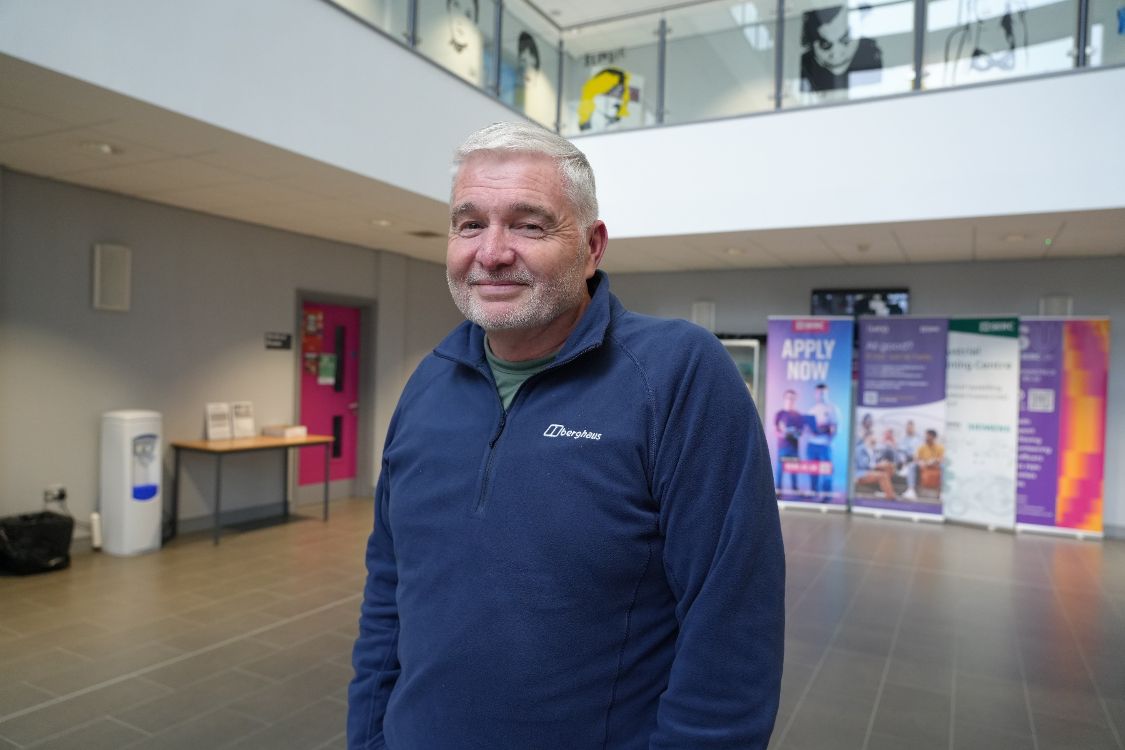
Roger McKee, Work Placement and Internal Quality Assessment Officer at SERC, is keen to share his experience as part of the annual awareness raising campaign, with World Stroke Awareness Day falling on 29 October.
Roger who is 58 and from Ballynahinch, was a lecturer in plastering on SERC Lisburn Campus. On Saturday 20 January 2024, Roger was preparing to leave his home to do the usual weekly grocery shopping with his wife Marie. When they were just about to go out the door, Roger had, what he describes as double vision – not the usual Face-Arms-Speech signs (FAST with T for Time to take action – see below) that we are told to associate with a stroke. Roger says, “The double vision sensation came, and it went, but thankfully there was something that raised alarm bells with my wife Marie. We were in the car and Marie told me we weren’t going shopping we were going to the hospital.
“I woke up three days later, on Tuesday 23 January with absolutely no recollection of the last few days. It was frightening. I didn’t know where I was, or how I got there. The nurse told me I had had a stroke. All that was in my head was that I had to get home and get the students’ work marked – I had planned to do some marking over that weekend.
“I couldn’t accept or comprehend what was going on. I remember going for an assessment where I was asked to move from one spot on the floor to another. I could see what I had to do but I had no idea what to do. I couldn’t work it out. You cannot imagine the confusion I was experiencing. I had lost my short-term memory. I couldn’t get the letter S out, which is bizarre.”
Roger continues, “I was sent home on the Thursday and that’s when the Stroke Team took over – these are nurses and staff with specialist skills all working together with you in the aftermath of a stroke. I had a lot of work to do, and the team work with you on a programme of cognitive and physiotherapy. The Stroke Team also introduces you to a range of organisations who help you on the way to recovery, including the Stroke Association - there is a group which meets each Thursday in Ballynahinch. Initially, I didn’t want to go along, but Marie encouraged me - though I might say ‘forced’ me! At each session, we did exercises, followed by a chat, maybe on healthy eating or something similar. It helped me by meeting other people affected by a stroke. They understood what I was going through. I went back for another six weeks, and I loved it.”
Roger is still affected by his stroke, though he has made major progress. He had to learn to walk again and how to negotiate a step, but is now able to walk with just a stick. He says, “If I had just met someone, they wouldn’t know I had had a stroke, and because I now use a walking stick, you might think I had a dodgy hip or knee. I know I am a lot better than I was immediately following the stroke, and I have learnt to manage what has happened. For example, if I was doing something and then went off to have a cup of coffee, I would have to write down what I was doing first to help me pick up where I left off.”
He adds, “At home, it was relearning simple things like planting bulbs or – and some of you women might laugh - learning how to turn on the dishwasher. I think Marie had to show me every day for months how to do that. She has the patience of a saint; I couldn’t have got to where I am without her love, care and support.”
Roger did learn that when he was first diagnosed, his blood pressure was extremely high and there is no doubt that this was a major factor in his stroke. He is keen for others to take up any opportunity to get their blood pressure checked. As part of his recovery routine, Roger’s blood pressure is taken daily by his wife, and then every three weeks he attends his doctor for the same. He said, “A stroke can happen to anyone at any time, so it is important to look after yourself and take action if you feel unwell.”
Both the Stroke Association and the Cedar Foundation worked with SERC HR team on Roger’s behalf for a phased return to work and a change of role. He says, “Another organisation who offer support is the Chest, Heart and Stroke Association. They get you to set a goal for yourself and my goal was to get back to work and that is where I am. The college has been so good in helping me get me back to my new normality.”
Roger would like to pay special tribute to colleagues, John Ambrose, Lynda Joyce, and Malachy Node who have provided tremendous support in getting him back on track.
Know the signs Recognising the symptoms of a stroke is crucial.
Remember F.A.S.T
F. face drooping,
A. arm weakness,
S. speech difficulties,
T. time to call emergency services.
This approach can help you to identify strokes quickly.
Prevention Up to 90% of strokes are preventable through lifestyle changes such as taking regular exercise, maintaining a healthy diet, and managing risk factors such as high blood pressure or diabetes.
Page Tags
SERCLatest News
Keep up with the latest from SERC